
This poetic life
Revelling in the poetry of ordinary things

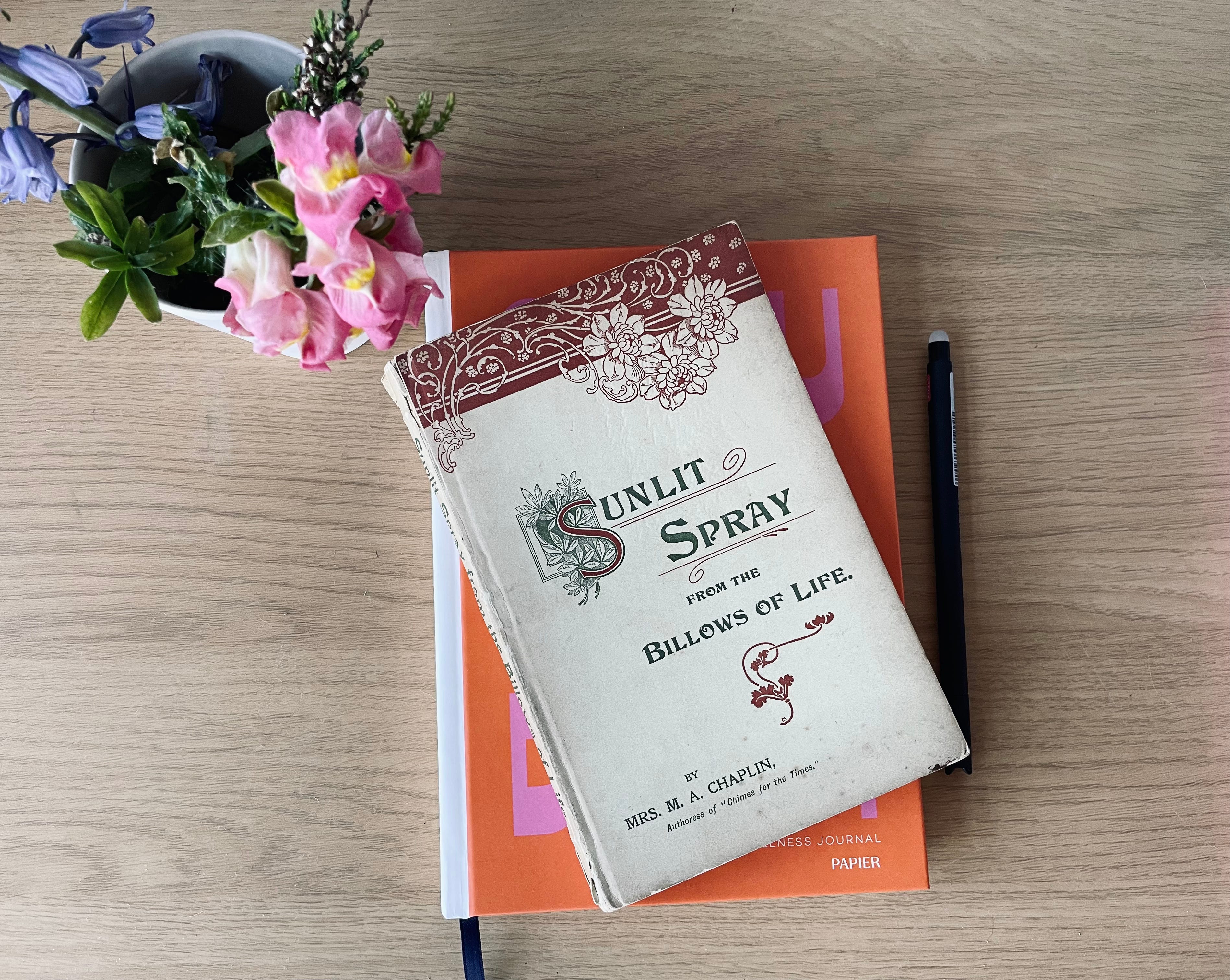
“I was satisfied then, and am now, to present the ordinary thoughts of ordinary people in ordinary language, and if you ask, "Where is the charm of verse if it is made up of common matter?" I reply, "That to see an every-day thought clothed in poetry makes just as much difference to it as it does to see the sea under a leaden sky, and then to look at it under, or in, the sunlight.” - Sunlit Spray from the Billows of Life, Mrs M. A. Chaplin
I find myself being pulled back, over and over, to the poetry of the ordinary in recent weeks. It started with this lovely little volume, discovered in a pre-loved bookshop at The National Trust’s Quarry Bank Mill. The quote above appears in the author’s preface and struck me as so lovely and so true. It reminded me strongly of one of my favourite moments in Greta Gerwig’s fabulous adaptation of Little Women, in which Jo and Amy are discussing what makes something important and worthy of being written about:
JO
Who will be interested in a story of domestic struggles and joys? It doesn’t have any real importance.AMY
Maybe we don’t see those things as important because people don’t write about them.JO
No, writing doesn’t confer importance, it reflects it.AMY
I’m not sure. Perhaps writing will make them more important.
Just a few days later, I was catching up with the recording of Nelly Bryce’s latest poetry circle that I was unable to join live. In it, LeeAnn Pickrell shared a couple of poems from her recently published collection Gathering the Pieces of Days and the opening line of the first poem she read instantly echoed the quote from Sunlit Spray from the Billows of Life.
LeeAnn’spoem opens with:
“Who will read these poems
of ordinary life?
Of days I can hardly remember.”
I seem to be surrounded by reminders that even the most mundane of moments and settings can be beautiful when we take the time to notice. This same reminder appeared again this week when I joined Lyndsay Kaldor’s Seasonal Salon - a nourishing space in which we were invited to reflect on our experience of the transition from winter to spring, anchor ourselves in the moment of this season, and craft our intentions for the months ahead. During the Salon, Lyndsay invited us to consider the question: What does wonder feel like?
What leapt to mind in response was an image of my little one, toddling round our garden, park, local woodland, picking up every stick and stone and leaf that catches his and holding it up to me in wonder.
“Wonder feels like remembering. When my son brings me a pebble, a feather, a flower and holds it up for me to see with awe and joy in his eyes, desperate to share this remarkable thing he has discovered, I remember - in a rush, all at once - that this world I move through every day is not in the least ordinary or mundane. It is full of wonder”.
We forget, in the busyness of adult life, that we too were once fascinated by every tiny, ordinary thing that the world presents to us. That there is a multitude of things to be marvelled at every day. That our very existence, the very fact of this world, is genuinely and completely miraculous. We humans have made the world a heavy place, with our wars and our politics and our greed. The news cycle is filled with horrors of our own creation and so often that feels unbearable. Overwhelming in its enormity, I find myself desperate to do something to change it, to make it better, whilst being simultaneously paralysed by the feeling of my own helpless insignificance.
This, of course, is dangerous territory. Because succumbing to those feelings of overwhelm and helplessness is precisely what the perpetrators of most of the world’s harms want from us. If we succumb, we don’t act, we don’t speak up.
Here is where the power of the poetic ordinary offers us a lifeline.
Because yes, there is horror in the world, but there is also wonder. Magic. Love. Beauty. Community. Marvels of nature. And when we pay attention to those things, we are reminded of what we must stand up for and protect. Because every person on this planet deserves a life marked by wonder rather than terror. Every person deserves to savour the tiny, seemingly insignificant moments in their day - that first sip of coffee, the play of light through the trees, the feel of the earth under their feet, sun or rain or wind on their skin, the comfort of community. Every person deserves to simply live, in the fullness of themselves, with their needs met, free of fear - free to enjoy the world’s little wonders.
And so we clothe our every day in poetry. A defiant celebration of what it truly means to be human. And we hold onto our hope, pushing back the darkness that some would spread. Nourishing ourselves and our communities with words, so that we maintain the strength to take action.
As so often happens when I sit down to write, this piece has taken me in an unexpected direction. I almost feel like I should finish it with a rousing, political poem but, then again, that might defeat the message. I don’t have one of those for you, anyway. Instead, I’m going to share the two poems I wrote during the Poetry Circle I mentioned at the beginning, for no other reason than I enjoyed writing them!
A non-exhaustive list of things I’m not sorry for
I'm not sorry that life is spilling messily
out of the edges
of these oh-so-neat little boxes
presented to us by a society that wants
everything
framed and filtered and in its 'right place'.
I'm not sorry for the mud on his knees
or the food on his smiling face
or the tangles in his hair as he
runs
exuberant in his wildness and freedom.
I'm not sorry for the unfolded laundry
or the dust gathered on the TV stand
because my hands were too busy building towers
or holding books
to wipe it down.
I'm not sorry for turning off my computer
at the end of the working day
or for choosing to stay present in his world of
make believe
as he hands me a pretend cup of coffee
made with Duplo and sticky fingers.
I'm not sorry for taking the nap I took
when I needed it
or the new roundness of my body
or for choosing to eat the chocolate
rather than worry about 'bouncing back',
or for going back to work when he was only one
or for working condensed hours so I can spend more time with him
or for getting it 'wrong'
or following my own sense of what's right.
I am not sorry for living this
wild
and messy life.
I am not sorry for living.
And finally, inspired by a line from Joy Sullivan’s poem Howl, from her exquisite collection Instructions on Travelling West:
“I am finally a woman willing to feed herself”
Our Poetry Circle host, Nelly, asked us to consider what a woman willing to feed herself looks like, and write from there…
She is robed in contentment
and quiet confidence
revelling in the space she fills
with her unflinching commitment
to savouring all she desires.
She fills her plate and her cup
with all she needs -
listening to the yearnings of her
heart
soul
body
and carefully selecting
only that which will serve and nourish her.
She eats
and drinks
and rests
and dances
and loves
until she is full
of herself.
I’d love to know what ordinary things speak poetry to you, or what would be on your list of things you’re not sorry for, or what a woman willing to feed herself looks like to you - let me know in the comments or come on over to the Thrive in Chaos chat to share whatever strikes you.
Thank you, as always, for taking the time to read. I appreciate you.
Go gently.
Jen x
You write of the ordinary, and in doing so have written something extraordinary. 🤗🥰
Oh Jen, I found this so moving. Thank you for sharing these beautiful affirmations of the importance of sharing the beauty of the everyday, because really what else is there?! I love the idea of clothing the day in poetry and I of course, loved being reminded of the Little Women exchange and your incredible poetry, here's to being unapologetic and full of ourselves. P.S. thank you too for mentioning the Salon, I am so happy to hear that it led you down a path of wonder xx